


We’re excited to bring you a special edition from Leviathan News — a deep-dive research report published in collaboration with our sponsor, f(x) Protocol.
This isn’t just another update; it’s a comprehensive, high-quality analysis crafted to give you a clear and insightful look into one of the most innovative projects in DeFi.
We’ve gone the extra mile to ensure this report meets the highest standard of research, and we’re proud to share it with our community first.
A Stablecoin Renaissance in DeFi
Stablecoins have become foundational in decentralized finance (DeFi), supporting everything from decentralized exchanges and lending platforms to yield farming strategies. With the stablecoin market now exceeding $200 billion, their role has expanded significantly, driving adoption not only in mature economies but also in emerging markets across Asia, Africa, and Latin America. In these regions, stablecoins provide financial inclusion, protection against inflation, and crucial global market access.
A Taxonomy of Stablecoins

Explore the different types of stablecoins, their regulatory landscape, and how they are shaping the future of digital finance. From fiat-backed to algorithmic models, discover their impact on payment
However, today's stablecoin landscape is far from perfect. Most stablecoins face what is known as the "Stablecoin Trilemma," where projects typically compromise between decentralization, stability, and capital efficiency. Centralized stablecoins like USDC and USDT excel in stability and efficiency but sacrifice decentralization, introducing substantial risks. On the other hand, decentralized stablecoins, such as DAI, prioritize decentralization but often struggle with excessive collateralization, limiting their scalability and capital effectiveness.

Recognizing these persistent challenges, Aladdin DAO—a collective known for innovative DeFi solutions—created f(x) Protocol in direct response to the 2023 banking crisis and the subsequent USDC depeg event. Their goal was straightforward: to design a stablecoin solution that is decentralized, highly efficient, and resilient enough to withstand similar market shocks.
f(x) Protocol addresses this challenge with a dual-token model, featuring a decentralized stablecoin (fxUSD) and a leveraged asset (xToken). Rather than simply eliminating volatility through heavy collateralization or complicated algorithms, f(x) Protocol effectively redistributes market risk. This allows fxUSD holders to maintain stability while xToken holders benefit from leveraged exposure to crypto price movements.
By tackling the Stablecoin Trilemma head-on, f(x) Protocol positions itself uniquely within the growing stablecoin ecosystem. As the stablecoin market continues its rapid global expansion, f(x) Protocol's innovative approach provides a compelling alternative to current solutions, potentially bridging critical gaps left by centralized and over-collateralized stablecoin models.
This report explores how f(x) Protocol 2.0 enhances stablecoin mechanics and leveraged trading, emphasizes the importance of its capital-efficient model, and considers its potential to bring decentralized finance closer to mainstream adoption.
The Genesis of f(x) Protocol
Why Aladdin DAO Created f(x)
The inception of f(x) Protocol can be traced directly to the turbulence experienced in global financial markets in early 2023. The rapid collapse of Silicon Valley Bank triggered widespread panic and exposed deep vulnerabilities in traditional financial infrastructure. This crisis notably impacted the cryptocurrency industry, most prominently affecting USDC, a leading centralized stablecoin whose issuer, Circle, held significant reserves with Silicon Valley Bank. During this turmoil, USDC temporarily lost its peg, dropping to approximately $0.87, highlighting the systemic risks tied to centralized reserves.
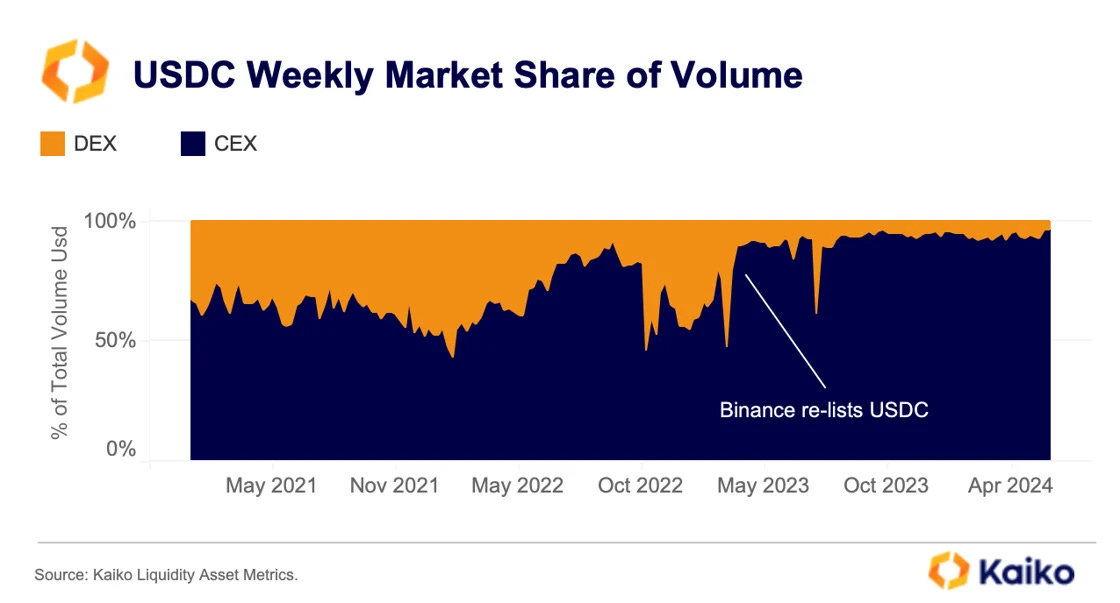
Recognizing these vulnerabilities, Aladdin DAO saw a clear need for a new stablecoin framework—one that minimized reliance on centralized financial institutions. Their goal became clear: design a stablecoin solution resilient enough to withstand severe market disruptions, ensuring robust decentralization, scalability, and improved capital efficiency.
Aladdin DAO understood that achieving this required a complete rethink of stablecoin architecture. Rather than relying on opaque reserves or algorithmic backing that often proved fragile under stress, Aladdin DAO aimed to introduce transparency, decentralization, and robustness into stablecoin mechanics. This vision gave birth to f(x) Protocol, designed explicitly to withstand shocks similar to the USDC depeg, by embedding systemic risk management into its foundational mechanics.
f(x) Protocol v1: An Imperfect Vision
The initial version of f(x) Protocol introduced an innovative dual-token system using two assets—fETH and xETH—to segregate volatility and provide leverage. This model represented an ambitious first attempt at addressing the stablecoin trilemma. However, f(x) Protocol v1 encountered a significant limitation:
Unpredictable Leverage Ratios: The initial model lacked mechanisms to reliably control leverage levels, resulting in unpredictable leverage exposure. This unpredictability made it difficult for users to manage risk effectively, undermining confidence and limiting broader adoption.
Acknowledging this early challenge, Aladdin DAO significantly refined the protocol, resulting in the launch of f(x) Protocol 2.0. The upgraded version incorporated predictable fixed leverage , an advanced automated rebalancing mechanism to mitigate liquidation risks, and a strengthened stability pool. These improvements collectively enhanced the protocol’s reliability, user confidence, and overall resilience, directly addressing the limitations of its predecessor.
The Stablecoin Trilemma & f(x) Protocol’s Solution
The Stablecoin Trilemma refers to the inherent trade-offs stablecoin issuers face between decentralization, stability, and capital efficiency. Historically, stablecoins have achieved success in two of these areas while inevitably compromising the third.
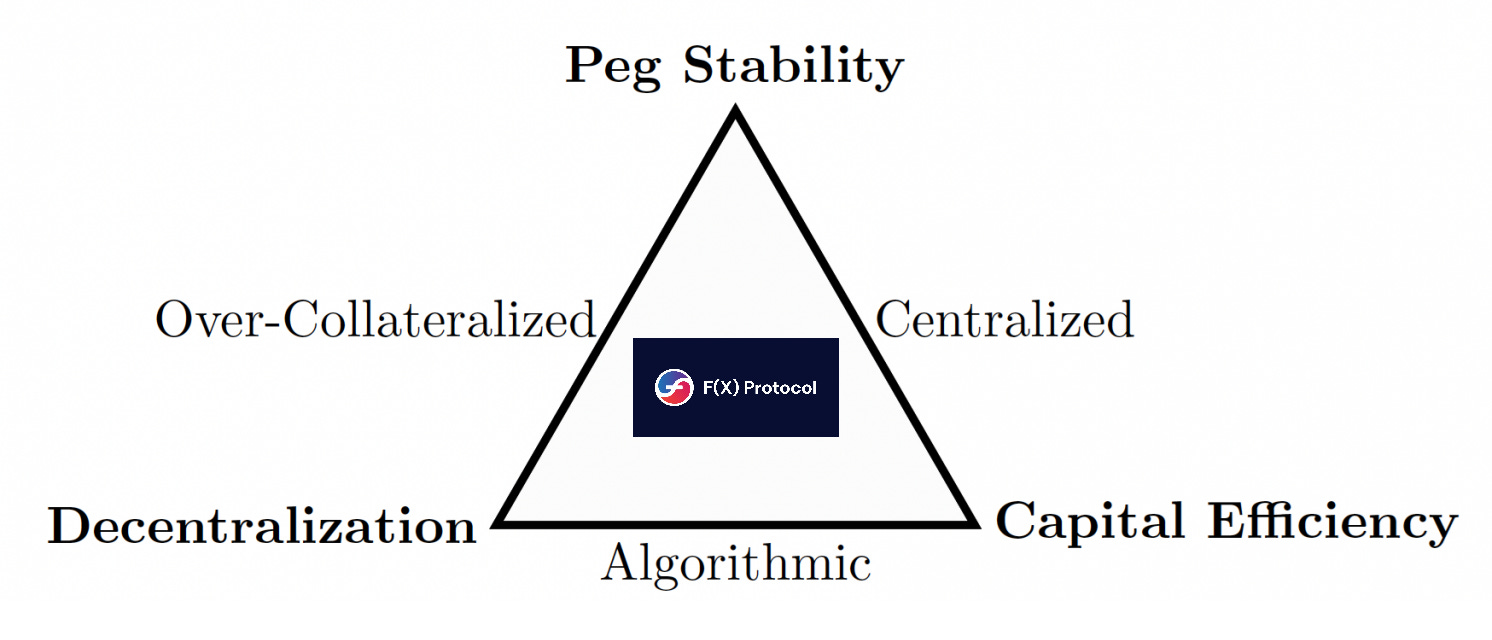
Centralized stablecoins like USDC and USDT prioritize stability and capital efficiency through reliance on traditional financial institutions and centralized reserves. This approach ensures stability but introduces centralization risks such as vulnerability to regulatory actions and systemic banking crises, exemplified by USDC's 2023 depeg event.
Decentralized stablecoins, including MakerDAO’s DAI, favor decentralization and stability but typically require heavy over-collateralization, often as high as 150% or more. This excessive collateralization locks up significant amounts of capital, restricting overall scalability and reducing potential productivity.
Algorithmic stablecoins attempt to offer decentralization and capital efficiency by using automated algorithmic adjustments to maintain stability. However, their complexity and reliance on fragile incentive mechanisms have proven risky, as seen with the dramatic collapse of Terra’s UST, which wiped out significant market value and investor trust during periods of high volatility–as well as becoming a defining event of the previous cycle’s “crypto winter”.
f(x) Protocol’s Unique Approach
f(x) Protocol addresses the Stablecoin Trilemma through an innovative dual-token model designed explicitly for decentralization, stability, and capital efficiency:
Dual-Token Structure (fxUSD & xPOSITION):
Users deposit yield-bearing crypto assets, such as liquid staking derivatives like stETH, to mint fxUSD (stable asset) and xPOSITION (leveraged asset).
Instead of neutralizing volatility, the protocol redistributes it. fxUSD retains stability, backed dollar-for-dollar by collateral, while xPOSITION captures and amplifies underlying asset volatility for leverage-seeking investors.
Capital Efficiency
Unlike protocols such as MakerDAO, which require over-collateralization (e.g., locking up 150% collateral to mint just $1 in stablecoins), f(x) Protocol ensures every fxUSD token is fully backed without needing excess collateral. The protocol's collateral is entirely yield-bearing, actively generating returns for fxUSD stakers. Users benefit from capital efficiency by unlocking otherwise dormant capital, amplifying the productive utility of their crypto assets.
Decentralization
f(x) Protocol preserves decentralization by being entirely on-chain and permissionless. Users mint fxUSD and xTokens directly via smart contracts without intermediaries. Governance decisions and collateral selection are managed transparently through FXN holders and the broader community, limiting centralization risks inherent in stablecoins like USDC.
Stability
Stability is a cornerstone of f(x) Protocol, guaranteed through built-in risk management and rebalancing mechanisms rather than opaque algorithms or centralized collateral reliance. The protocol’s automatic rebalance mechanism maintains system solvency, adjusting leverage dynamically to mitigate volatility. Additionally, f(x) Protocol employs a dedicated stability pool that enhances fxUSD’s peg resilience, allowing rapid arbitrage and market-driven peg correction without the typical inefficiencies of decentralized stablecoins.
Big Picture: f(x) Protocol vs. Established Alternatives
Versus MakerDAO (DAI): f(x) eliminates Maker’s inefficient over-collateralization requirement, providing equivalent stability with significantly higher capital efficiency.
Versus Frax (FRAX): Unlike Frax v1’s hybrid algorithmic model, f(x) Protocol’s peg stability relies purely on transparent, on-chain mechanisms, significantly reducing long-term stability risks.
Versus Liquity (LUSD): f(x) achieves greater scalability by not relying on aggressive liquidation mechanisms and instead using automated rebalancing and risk management strategies, enhancing both stability and usability.
By innovatively balancing these core aspects—capital efficiency, decentralization, and stability—f(x) Protocol introduces a compelling and practical approach to stablecoin design. It addresses critical deficiencies prevalent across current stablecoin models, positioning itself uniquely as a protocol that can sustainably scale in decentralized finance.
How f(x) Protocol 2.0 Works
Key Upgrades from v1 to v2
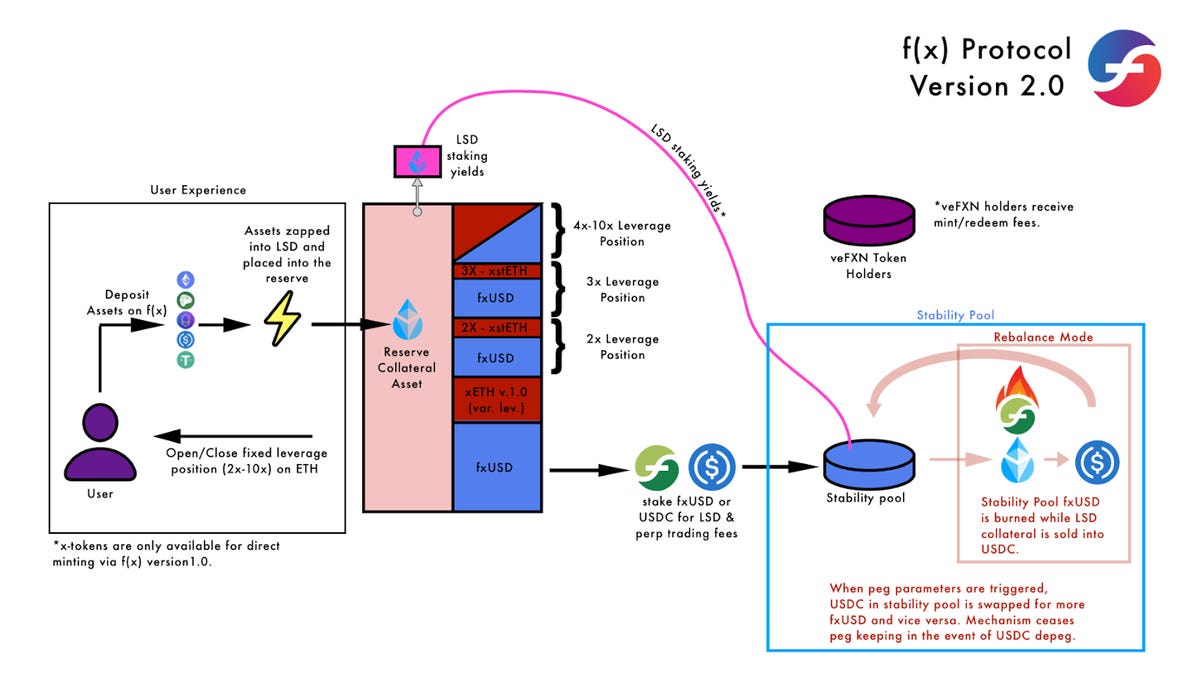
Building on lessons learned from v1's limitations, f(x) Protocol 2.0 introduces several critical upgrades designed to significantly enhance usability, stability, and capital efficiency.
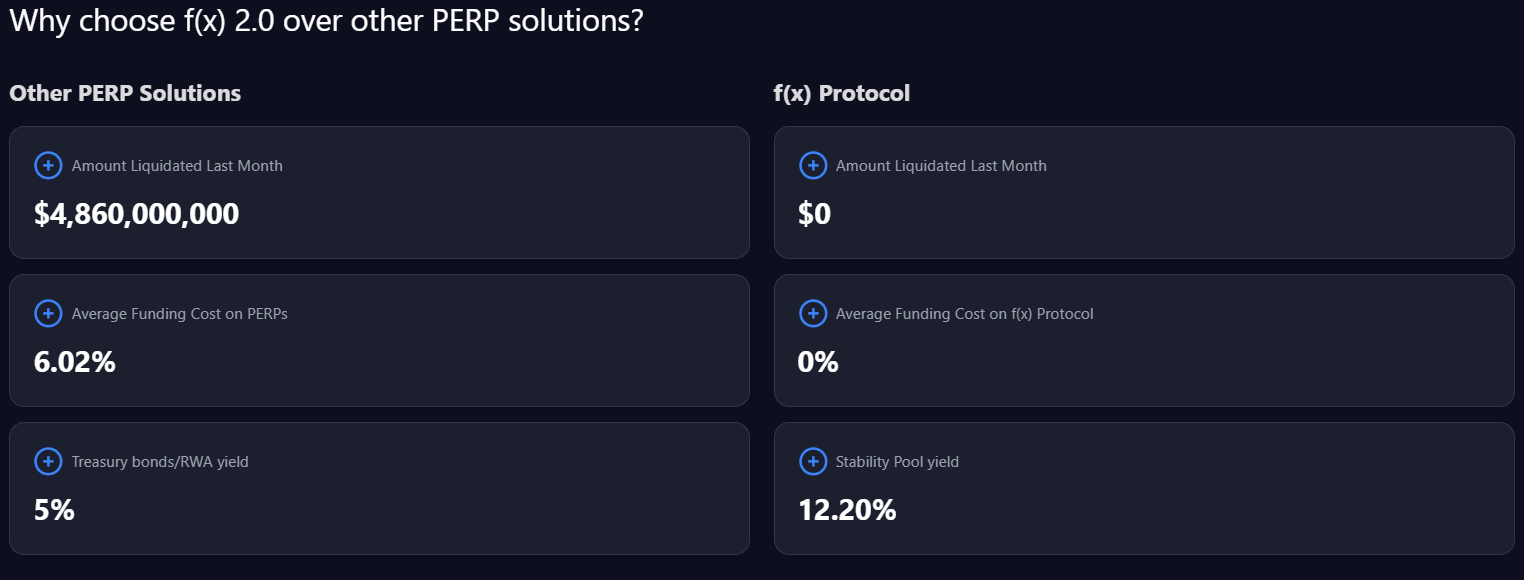
Fixed Leverage Trading (up to 7x with 0 Funding costs): f(x) Protocol 2.0 introduces fixed leverage positions, providing users predictable exposure with minimal liquidation risks typically associated with leverage trading. Unlike traditional perpetual trading platforms, f(x) removes uncertainty by minimizing liquidations, eliminating the need for constant monitoring or complex position management.
Automated Rebalancing Mechanism: One of the most significant improvements in version 2.0 is the implementation of an automated rebalancing system. This mechanism proactively manages collateral and leverage, continuously adjusting user positions to maintain protocol solvency even during extreme market conditions. By automatically redistributing assets, the protocol effectively removes the individual liquidation risk inherent in typical leverage platforms, providing a robust safeguard for user funds.
Enhanced Stability Pool: Recognizing the critical role of peg stability, f(x) Protocol redesigned its stability pool in version 2.0. This improved stability pool significantly enhances the protocol's peg resilience by facilitating efficient arbitrage opportunities. It incentivizes participants to actively maintain the stablecoin’s peg, ensuring greater market confidence and smoother price stability compared to the earlier model.
The f(x) Invariant (Simplified Explanation)
At the core of f(x) Protocol’s innovative design is the "f(x) invariant." This foundational principle guarantees that every fxUSD token minted remains fully collateralized at all times. Rather than eliminating market volatility outright, the invariant redistributes volatility by clearly separating stable assets (fxUSD) from leveraged assets (xPOSITIONs). The f(x) invariant ensures protocol balance and solvency through transparent on-chain mechanisms, providing users and stakeholders with consistent and reliable assurance that their positions are adequately protected. (For the tech junkies, here’s a detailed technical explanation of the invariant, per f(x) official docs.)
Minting and Redeeming Mechanics
Minting and redeeming fxUSD and xPOSITION tokens in f(x) Protocol 2.0 is straightforward yet carefully managed for risk control. Users can deposit stablecoins or other yield-generating assets like stETH, simultaneously minting stable fxUSD and leveraged xPOSITIONs. The protocol dynamically adjusts minting and redeeming amounts to maintain predefined leverage levels, ensuring positions remain balanced and aligned with user expectations.
Risk Management Innovations
Recognizing that stability and trust depend heavily on effective risk management, f(x) Protocol 2.0 introduces several key innovations:
Automated Rebalancing: The automated rebalancing system actively manages leverage, preventing excessive exposure and ensuring user positions remain stable even during severe volatility.
Bad Debt Redistribution: In extreme conditions, if collateral values decline sharply, the protocol redistributes potential shortfalls proportionally across xPOSITION holders. This mechanism ensures the solvency of fxUSD at all times, maintaining trust and stability throughout market turbulence.
Reserve Fund: Additionally, f(x) Protocol maintains a dedicated reserve fund financed through protocol-generated revenues. This fund provides an extra layer of security, acting as a buffer against unforeseen events and ensuring long-term protocol solvency and user confidence.
These upgrades collectively position f(x) Protocol 2.0 as an innovative, resilient, and capital-efficient solution designed to withstand market pressures while maintaining user confidence through clear, effective risk management.
Performance & Adoption Metrics
Growth of f(x) Protocol
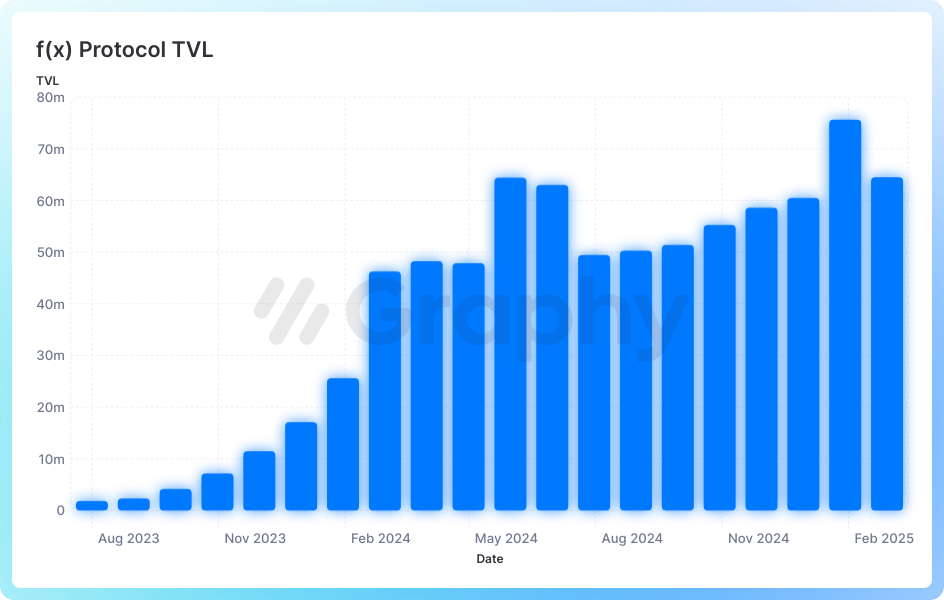
Since its inception, f(x) Protocol has demonstrated robust growth and consistent adoption within the broader decentralized finance ecosystem. Under its initial v1 contract, the protocol experienced significant momentum, with Total Value Locked (TVL) rising from approximately $1 million in August 2023 to a remarkable peak of $70 million in June 2024. This impressive trajectory underscored increasing user confidence in the stability, transparency, and overall value proposition offered by the protocol.
A subsequent decline in TVL occurred shortly after this peak, primarily driven by the protocol's deliberate transition from v1 to the enhanced v2 contract. During this upgrade process, v1 pool participants were encouraged—and eventually required—to migrate their assets to v2, while new capital inflows into the original pool ceased. Additionally, as a strategic precaution to prevent unforeseen risks or disruptions, the new v2 pools temporarily restricted new user entry until a majority of the existing v1 liquidity had successfully transitioned to the upgraded contract.
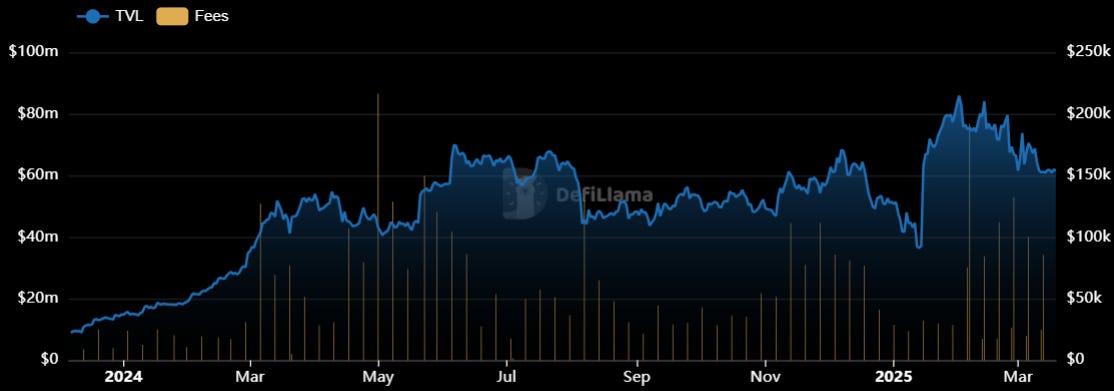
After the successful migration, TVL rebounded strongly at the start of 2025, surpassing its previous peak and reaching approximately $86 million by February 1, reflecting renewed market confidence in the upgraded v2 framework. However, market conditions shifted dramatically once again, as global financial markets became unsettled due to escalating trade tensions. The resulting widespread "risk-off" sentiment reduced user appetite for leveraged financial products, ultimately leading to a pullback in the protocol’s TVL.
In parallel to TVL growth, f(x) Protocol has actively diversified its product offerings. Originally focused primarily on stETH-based collateral, the protocol introduced multiple new stablecoin products, including rUSD, btcUSD, and rUSD. This strategic diversification broadened the protocol’s appeal, accommodating a wider range of user preferences and risk profiles, and significantly increased its potential market reach.
Strategic ecosystem partnerships have also been a key driver of the protocol's adoption and integration within the DeFi landscape. Collaborations with industry-leading platforms such as Convex and StakeDAO have substantially improved liquidity conditions, expanded yield opportunities, and facilitated deeper institutional engagement. These partnerships reinforce the protocol’s reputation and underscore growing institutional interest in fully decentralized stablecoin alternatives that effectively balance capital efficiency, decentralization, and stability.
To maintain its current growth trajectory, f(x) Protocol will need to continue addressing barriers to adoption, such as simplifying user experience and expanding educational initiatives. Improving accessibility and clearly communicating its advantages relative to centralized and algorithmic alternatives will be critical in sustaining and accelerating future user adoption.
Real-World Use Cases
f(x) Protocol’s innovative mechanisms unlock practical applications that distinctly differentiate it from conventional stablecoin and leverage platforms. One such use case is stablecoin yield farming, where f(x) Protocol's capital-efficient design provides substantial improvements over traditional Collateralized Debt Positions (CDPs). Users are able to deploy collateral more effectively, minting fxUSD directly from yield-generating assets, thus significantly enhancing their overall capital productivity and yield potential without incurring excessive collateralization.
Another key application is fixed leverage trading. As DeFi traders increasingly look for leveraged exposure without the inherent risks of liquidations and high funding fees seen on traditional platforms, f(x) Protocol uniquely addresses this need. The protocol’s xPOSITION tokens offer predictable, fixed leverage exposure, delivering traders a cost-efficient and risk-managed approach to leveraged trading.
These real-world applications underscore f(x) Protocol’s distinctive value proposition and highlight its practical appeal to both yield-focused stablecoin users and leverage-seeking traders.
Navigating Uncertainty & Instability: Addressing Adoption and Risk Factors
Adoption Challenges
Despite its innovative approach and promising early traction, f(x) Protocol faces common adoption hurdles associated with emerging DeFi platforms. One major challenge is competing against well-established stablecoins like USDC, USDT, and DAI, which already benefit from deep market integration, substantial liquidity, and strong user confidence. Convincing users to transition from these familiar solutions will depend heavily on demonstrating f(x) Protocol’s clear advantages in capital efficiency, decentralization, and risk management.
Furthermore, the complexity of f(x) Protocol’s dual-asset mechanism could present an additional barrier to mainstream adoption. To overcome this, the protocol may need to simplify the user experience, enhance user-friendly interfaces, and actively expand educational outreach. Addressing user accessibility and providing clear explanations of how the protocol works could significantly reduce friction for new participants, facilitating broader adoption.
Expanding integration within the broader DeFi ecosystem also remains critical. Although strategic partnerships with platforms like Convex and StakeDAO signify promising progress, ongoing partnership development and ecosystem integration will be necessary to ensure sustained user adoption, liquidity growth, and increased visibility.
Risk Considerations
One of the primary risks associated with stablecoins, including fxUSD, is potential peg instability during periods of extreme market volatility. Although f(x) Protocol employs sophisticated automated rebalancing, a robust stability pool, and reserve fund mechanisms, unprecedented market scenarios—or "black swan" events—still pose genuine challenges. Effective liquidity management during such extreme volatility will be essential, emphasizing the importance of the protocol’s built-in automated rebalancing features, dedicated stability pool, and reserve fund as critical protective measures.
fxUSD has a number of pegging mechanisms to keep fxUSD well pegged at all times.
Another key consideration involves the scalability and sustainability of the xPOSITION leveraged model. As the protocol continues to grow and attract more users, maintaining balanced leverage ratios without compromising stability or introducing undue complexity will be crucial. Ensuring that the leveraged product can scale efficiently across varying market conditions remains a central priority for f(x) Protocol’s long-term viability.
Regulatory Uncertainty
Regulatory ambiguity surrounding stablecoins represents another significant area of concern. Future regulatory changes could dramatically affect stablecoin governance structures, issuance processes, and overall market participation. To address these potential uncertainties, f(x) Protocol emphasizes its decentralized governance approach and transparent on-chain collateral management systems. This proactive stance helps ensure regulatory compliance without sacrificing decentralization—preserving the core ethos of the protocol while preparing for future regulatory landscapes.
Navigating these adoption and risk-related challenges effectively will be vital in determining f(x) Protocol’s sustained growth, user confidence, and ability to establish itself as a significant stablecoin solution in the evolving DeFi landscape.
The Future of f(x) Protocol
Potential for Expansion
f(x) Protocol has substantial room to expand its reach and enhance its role within the rapidly evolving DeFi ecosystem. One promising growth opportunity is deploying the protocol beyond Ethereum onto other leading blockchain networks. Multi-chain adoption could significantly broaden the protocol’s accessibility, liquidity, and user base, allowing f(x) to tap into diverse DeFi communities and ecosystems.
Another key opportunity lies in Layer 2 integration with platforms such as Arbitrum and Optimism and Base. By leveraging Layer 2 solutions, f(x) Protocol could substantially enhance transaction speeds, reduce fees, and improve user experience. These improvements would likely boost the protocol’s attractiveness to both retail and institutional investors, facilitating broader adoption and further strengthening its competitive position.
Could f(x) Become a DeFi Standard?
Given its innovative dual-asset model and clear advantages in decentralization, stability, and capital efficiency, f(x) Protocol is well-positioned to set new standards in DeFi stablecoin infrastructure. As the DeFi market matures and users grow increasingly aware of the limitations associated with centralized or over-collateralized alternatives, demand for f(x)’s approach—combining yield-generating collateral and predictable, fixed leverage—could increase significantly.
If successfully scaled and widely integrated across multiple chains, the f(x) Protocol has the potential to emerge as a benchmark for next-generation stablecoin solutions and establish itself as a foundational component of decentralized financial infrastructure.
Final Thoughts
The long-term viability and success of f(x) Protocol ultimately depend on consistent user adoption, rigorous security measures, and strategic integrations within the broader DeFi ecosystem. With its carefully designed architecture, proactive risk management strategies, and a clear focus on balancing usability with decentralization, it appears self-evident that f(x) Protocol is strongly positioned to achieve sustained growth and wider market acceptance. Crucially, there is a well-recognized dynamic among stablecoin users: the longer a stablecoin maintains its peg despite market turbulence and unforeseen mayhem, the stronger user confidence becomes, leading to accelerated adoption and deeper market penetration over time. As DeFi ecosystems evolve and user expectations continue to rise, f(x)’s practical approach could increasingly become a preferred standard, reinforcing its critical role in shaping the future of decentralized finance.
Links: X (Twitter) | Website
Thank you for taking the time to dive into this special report on fx Protocol—we truly appreciate your interest and support.
If you found value in this research, please consider sharing it with your friends, colleagues, or anyone else who might find this insightful.
Your referrals help our community grow and allow us to continue producing top-quality analysis. Thanks again for being a valued subscriber of Leviathan News!